

When people ask how many gallons of paint it takes to paint a 2,000 square foot house exterior, they usually expect a simple answer.
Most of the time, they’re thinking something like 5 to 10 gallons. A clean, easy number. Something predictable.
But in real-world painting, it doesn’t work that way.
The truth is, there is no fixed gallon number for a 2,000 square foot house. And the reason is simple: houses are not built the same, surfaces are not the same, and conditions are never the same.
Once you’ve been in this business long enough, you stop answering that question with a number and start answering it with a process.
Because that’s what actually determines how much paint gets used.
Why there is no “standard gallon number”
The biggest misconception is that square footage equals paint gallons.
It doesn’t.
A 2,000 square foot house can have completely different surface areas depending on:
- How much siding vs trim it has
- Whether it’s brick, stucco, wood, or vinyl
- How many stories it is
- How complex the architecture is
- How much of it is actually being painted
Two houses that are both “2,000 square feet” can easily require very different amounts of paint.
In reality, the only thing square footage tells you is size—not surface area.
And surface area is what actually matters. Estimating a 12×12 room is far simpler; an exterior is not.
What most clients assume (and where it goes wrong)
Most clients tend to assume a few things:
They assume:
- Paint is standardized across all contractors
- Spread rates on the paint can are accurate in real life
- A 2,000 sq ft house equals a predictable gallon count
- All painters calculate things the same way
The biggest assumption is the spread rate on the paint can.
Manufacturers usually list ideal coverage rates, but those numbers are based on perfect conditions. Smooth surfaces, ideal application, and one-coat scenarios.
In real life, those conditions almost never exist.
Actual coverage is often lower than what’s listed on the can, especially when you factor in texture, porosity, and real-world application methods.
The real factors that determine paint usage
When estimating paint for a 2,000 square foot exterior, there are several real-world factors that actually determine how many gallons are needed.
1. Surface area (the biggest factor)
The first and most important factor is simple:
How much surface are we actually painting?
Not the square footage of the house—the actual paintable surface.
Are we doing:
- Full siding?
- Just trim?
- Body and trim together?
- Accent areas?
Surface area is the single biggest driver of paint quantity.
2. Type of surface
Different materials absorb paint differently.
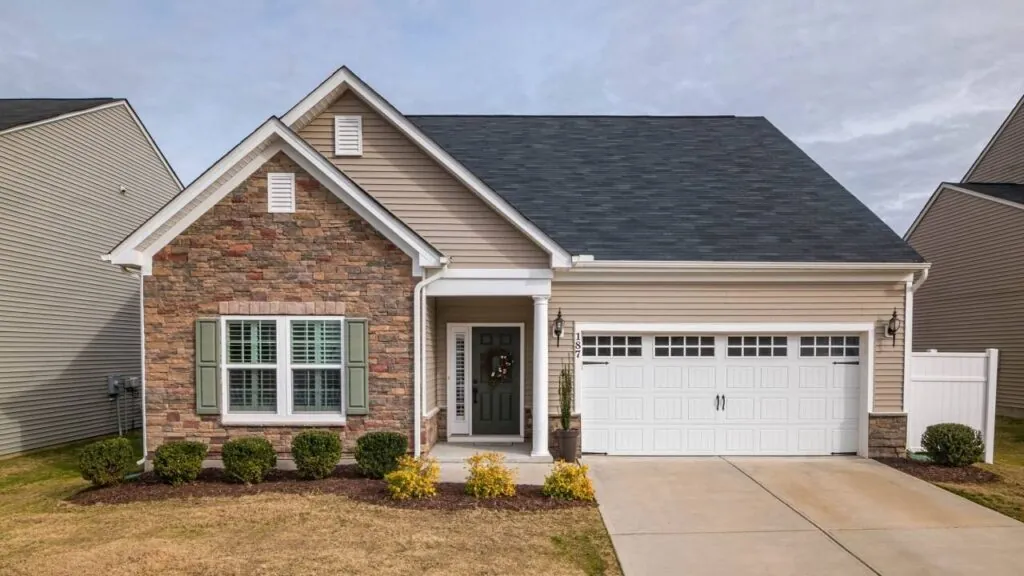
For example:
- Stucco acts like a sponge and absorbs significantly more paint
- Raw or weathered wood can be thirsty and uneven
- Previously coated surfaces may be smoother and require less material
The type of surface directly affects how far paint will spread.
3. Condition of the surface
Condition matters just as much as material.
You have to ask:
- Is the surface in good shape?
- Is it chalky or weathered?
- Is it already failing or peeling?
- Is it tight and sealed, or porous and dry?
A well-maintained surface will use less paint. A neglected surface will always use more.
4. Color changes
Color also plays a role.
Going:
- Dark to light usually requires more coverage
- Light to dark may require fewer coats but still depends on base color
Dramatic color changes almost always increase paint usage.
5. Number of coats
This is a big one.
Are we doing:
- One coat (rare in quality work)
- Standard two coats
- Extra coat for coverage or durability
Most professional exterior jobs involve two coats, which doubles material expectations right away.
6. Application method
How paint is applied affects usage:
- Spraying can increase usage due to overspray loss
- Brush and roll is more controlled but slower
- Combination methods affect efficiency and coverage
Overspray isn’t as big of an issue as it used to be, but it still plays a role in totals.
7. Primer requirements
Primer is often overlooked in homeowner estimates.
But depending on the house, you may need:
- Full prime coverage
- Spot priming for repairs
- Bonding primer for slick surfaces
- Specialty primers for stain blocking or wood tannins
Primer adds both labor and material to the total system.
What a real estimate process actually looks like
When we estimate a 2,000 square foot exterior, we don’t start with gallons.
We start with the house.

First, we measure all surfaces and break them down into actual paintable areas—siding, trim, accents, and anything else involved.
Then we look at condition.
Because condition tells you how much paint the surface is going to absorb. That alone can change everything.
After that, we bring it all together using a system we’ve refined over years of doing thousands of projects. It’s a spreadsheet-based approach that factors in surface area, condition, material type, and application method.
That system keeps us very accurate—usually within a small margin of error on material usage.
From there, we also factor in:
- color selections
- primer needs
- caulking requirements
- coating systems being used
At that point, we’re not guessing. We’re building a full system.
And we’ve done it enough times that it becomes very predictable.
Why paint can range so much on a 2,000 sq ft house
A 2,000 square foot house might use:
- Lower end: fewer gallons if it’s tight siding, minimal trim, and good condition
- Higher end: significantly more if it’s stucco, heavily trimmed, or poorly maintained
But even that range changes depending on prep work and coatings required.
That’s why giving a simple gallon number is usually misleading. And if the question behind the question is what it costs to paint the house, that is a separate calculation with its own set of variables.
Why some projects use more paint than expected
There are a few common reasons paint usage increases:
- Porous or aged siding absorbing more material
- Stucco or textured surfaces soaking up paint
- Dark-to-light color changes requiring extra coverage
- Additional coats for durability or appearance
- Primer requirements across large areas
- Spray application losses in open conditions
Each one of these adds up quickly.
Why we don’t sell paint in gallons
When we talk to clients, we don’t usually focus on gallons.
Because gallons are not the product.
The system is the product.
We’ve got this process down to where everything needed for the job is included and delivered to the project. Paint, primer, caulk—it all shows up ready to go.
At that point, the exact gallon count isn’t what matters to the client. What matters is that the job is done correctly and consistently.
That’s the focus.
Final takeaway
There is no universal answer to how many gallons of paint a 2,000 square foot house takes.
It depends on surface area, material, condition, coatings, color, and application method.
But more importantly, it depends on whether the job is being treated like a quick estimate—or a properly built system.
Because in real exterior painting, gallons don’t determine success.
Preparation and execution do.
Get a Free Estimate
Frequently Asked Questions
There is no fixed number. It depends on surface area, material type, condition, number of coats, and application method.
Because square footage does not equal surface area. Every house has different siding, trim, and texture that affects paint usage.
Yes. Stucco is highly porous and absorbs significantly more paint than smooth siding or previously painted surfaces.
Not always. Manufacturer spread rates are based on ideal conditions and often differ from real jobsite performance.
The biggest factor is total surface area being painted, followed closely by surface condition and material type.


